Tuesday, September 25, 2018

What Are the Benefits of Pure Glycerin Oil?

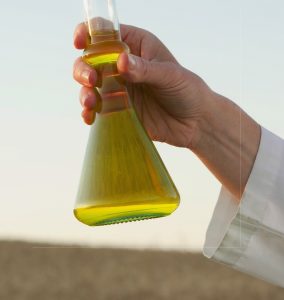
Glycerin is a thick liquid that is actually a by-product of the combination of water and fat. Nitroglycerin, an explosive, is made by combining glycerin with nitrogen under very precise conditions. Glycerin alone is safe and nontoxic. Glycerin is created during many different manufacturing processes, such as soap making and bio diesel production. Glycerin is known for its ability to absorb and hold water, as well as its sweet flavor.

Soap

Probably the most common use of glycerin is in soap. Actually, glycerin is a natural by-product of soap production. When fat is combined with a base and water, soap and glycerin are formed. Our ancestors simply left the glycerin in the soap. But modern manufacturers remove the glycerin to dry the bars. They use the glycerin in other cosmetics. Natural or homemade soaps are often very high in glycerin. Glycerin helps the skin maintain a natural water balance without oils.

Acne

Glycerin soap makes a great acne cleanser because it keeps the skin from drying out without clogging the pores. Used alone, or with a facial brush or washcloth, glycerin soap clears oil, dead skin, and other contaminants.

Skin Disease

According to Dr. Wendy Bollinger Bollag of Vanderbilt University, there is evidence to suggest that glycerin may aid in the healing of skin diseases such as psoriasis and eczema. The water-retaining benefits of glycerin appear to contribute to healthy skin cell maturation.

Moisturizer

Glycerin alone, or mixed with other compounds, makes a great moisturizer. Because of its ability to draw and hold water, it prevents skin from overdrying. Because it is non comedogenic, glycerin moisturizes without clogging pores.

Hair

The moisturizing benefits of glycerin are not limited to the skin. Dry or frizzy hair also benefits from the use of glycerin. Glycerin not only holds and draws moisture, but it also helps the outer layer of the hair shaft lie down. This gives hair a shinier, sleeker appearance.

Food

Glycerin is not only nontoxic, it is used in many foods. Its sweet flavor is used in place of sugar in many low-carb products. A type of sugar alcohol, glycerin has no effect on the blood sugar of non-diabetics. However, there is still much debate about its use by diabetics.

Monday, September 24, 2018

US glycerine market finely balanced in H2 2018

The US glycerine markets are seeing finely balanced supply/demand dynamics as the second half of 2018 ramps up.
Market participants are trying to gauge supply tightness in coming months, and the supply/demand balance is delicate.
With most US producers across the vegetable and tallow tiers sold out and fully contracted for the third quarter, there is discussion that any supply disruption could push pricing up in coming months.
“There was a Midwest producer who had a plant issue in the first quarter, and that caused some of their buyers to frantically try to source material and was one of the reason the market tightened up so quickly in Q1,” a seller said.
While the domestic supply situation remains snug, spot markets globally are starting to reflect the easing supply situation.
Glycerine supply continues to lengthen in southeast Asia with biodiesel producers ramping up production due to higher biodiesel demand as a result of a narrower price gap between palm oil and gasoil.
In Europe, a crude oversupply situation may ease in the fourth quarter, with less upstream biodiesel imports set to arrive into the European Union due to uncertainty over duties.
Looking to South America, many market players will be closely watching the outcome of the Argentine biodiesel trade fight with Europe.
Biodiesel producers and glycerine refiners in Argentina expect the EU to stop importing biodiesel in the second half of the year by imposing new tariffs in September or October.
The European Commission (EC) announced earlier in May that any biodiesel imports from Argentina will be registered from 24 May for the next nine months. This is in order to retroactively impose tariffs on those imports if the current anti-subsidy case finds biodiesel from the country is being subsidised.
Most biodiesel plants produce crude glycerine at a 1:10 ratio, while additional costs will have to be incurred to process the product into refined glycerine for higher value application.
Argentine biodiesel and crude glycerine production was sharply affected when the US imposed tariffs on Argentine biodiesel in November 2017.
Tarriffs on Argentinean biodiesel were set at over 72%, as required by the US Department of Commerce in November 2017.
Following the closure of the US biodiesel market to Argentine volumes, biodiesel production in Argentina declined by 20.5% in Q3 2017, according to the nation’s statistics agency (INDEC).
The Argentine biodiesel sector expects to export about 700,000 tonnes of biodiesel to Europe in 2018, but this impending decision by the EC could derail those import plans for the South American biodiesel giant, which would affect global glycerine supply and could see tighter supply in an already delicately balanced market.
US refined glycerine suppliers include Procter & Gamble, Vantage Oleochemical, Emery Oleochemical, Twin Rivers Technology, Peter Cremer North America, ADM, Cargill, Owensboro Grain, Louis Dreyfus and Future Fuels among others.

Saturday, September 22, 2018

What crude glycerin

Crude glycerine is merely glycerine in a less pure form. Hence, in its chemical composition, it does not differ from glycerol, as glycerine is correctly called.
It consists of carbon, hydrogen and oxygen atoms that, in their type of chemical bond – C3H5(OH)3 – represent a trihydric alcohol. In common language, glycerol is also known as propanetriol, irrespective of its degree of purity.
Therefore, we cannot conclude from the formula alone whether a chemical compound with the chemical formula C3H5(OH)3 is highly pure pharmaceutical grade glycerine or a less pure “crude” glycerine.
  • A Less Pure By-product
Less pure glycerine like crude glycerine is not a contaminated and thus unusable substance. On the contrary: the secret lies in its production. A large quantity of glycerine is generated in the production of biodiesel. The proportion of glycerine in vegetable oils such as rapeseed or palm is approx. 10%. Following initial processing, it has a typical purity grade of about 80 per cent and is still nothing more than a by-product.
The degree to which glycerine is condensed in a further distillation process and thus becomes purer is decisive for its later name. Crude glycerine contains a high proportion of hydrogen; i.e. it has a water content of 10 to 15 per cent. It also contains other substances, e.g. between two and eight per cent of crude ash.
After further chemical processing, glycerine can be used as a valuable raw material for the manufacture of numerous products in the chemical, pharmaceutical, and food industries. The glycerine content of then pure glycerine can be up to 99.9 per cent.
While pure glycerine is colorless and has a sweet taste, less pure glycerol stands out due to its usually brown color. It can also vary in color. In crude glycerine, the sweet taste that pure glycerine has is masked by the higher salt content. Otherwise, this substance has the same properties as pure glycerol. It dissolves in water and attracts moisture. Because it is less pure, crude glycerine is mainly used for industrial purposes. It is not pure enough for use in the pharmaceutical industry or for the production of food. Here its degree of purity would have to be 99.5 per cent.
The substance is also used in the agricultural sector, particularly for feeding cattle and fattening pigs as crude glycerine is very high in energy and much less expensive than pure glycerine. Therefore, it is used both as a technological additive in the production of animal feed, for example for stabilizing pellets, and as a single feedstuff. However, only glycerine with a degree of purity of 80 per cent is suitable as animal feed. According to the “white list” applicable since 2006, the substance may only be used for feeding animals if it was gained from vegetable fats and oils.

Friday, September 21, 2018

Chemical Properties of Glycerin

Glycerol is alcohols which contains three carboxyl. It has the chemical reactivity of general alcohols. Because he has three carboxyl groups, all glycerols have features of monohydric alcohols, diols and other different polyols. That the below chemical reaction of glycerin can explain the role of glycerin in chemical industry.

2.2.1 Oxidation of glycerin
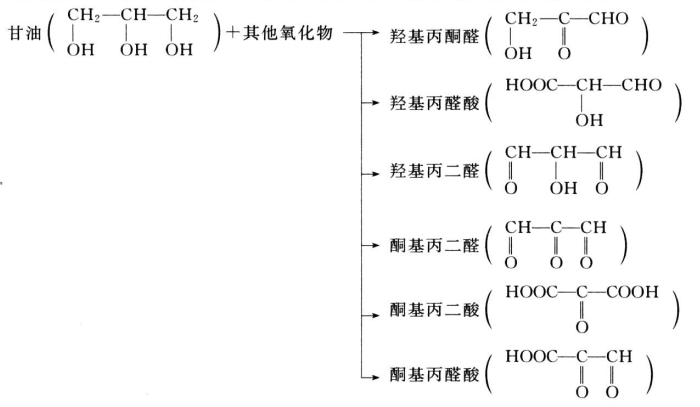
Under normal conditions, glycerin is stable in the atmosphere, but it is easily oxidized by other oxidants. Glycerin can be oxidized under different conditions to produce different compounds.
  1. In the presence of ferrous salts, Glyceraldehydes are formed under mild conditions with hydrogen peroxide.
  2. glycerol can be oxidized by nitrite oxidation.
  3. With the action of Acetobacter SP, two carboxy acetone was formed.
  4. reaction with calcium carbonate and hydrogen peroxide to form carboxyl malonic acid.
  5. Acrolein is produced by potassium hydrogen sulfate or potassium sulfate
  6. Other oxides that can be produced by reacting with other oxides include carboxyl pyruvic aldehyde, carboxyl pyruvic acid, carboxyl malondialdehyde, keto malondialdehyde, keto malonic acid, keto pyruvic acid, etc.
  7. Periodic acid oxidation: Periodic acid is a selective oxidant that can react with 1,2-ethylene glycol to break the carbon chain between consecutive methanol and produce aldehydes or ketones, which can be carried out in neutral or acidic conditions. When reacting with glycerol, the carbon atoms break at both sides of the intermediate carbon atom to form formaldehyde, and one carbon atom in the middle to form formic acid. This response is quantified. Therefore, it is one of the main methods of glycerol analysis.
  8. Epoxidation of glycerol with hydrogen chloride by intramolecular dehydration in the presence of catalyst to produce epichlorohydrin. Epichlorohydrin is widely used and plays an important role in the generation of epoxy resin. This reaction is expected to become the most important component of glycerol derivatives.
2.2.2 Reduction of glycerin
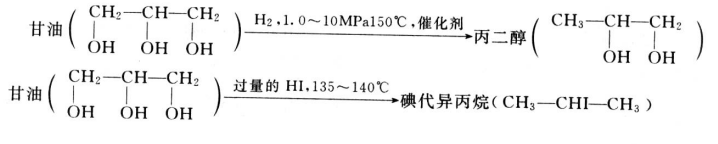
There is no industrial use of glycerin reduction reaction to produce other products, if the Ni, Fe, Pt, Au, Hg, etc. as a catalyst, at 150 degrees Celsius, with H2 reduction will produce propylene glycol. In addition, iodinated ISO propane is produced by reduction of excess hydrogen iodide at 135-140 C.
2.2.3 esterification
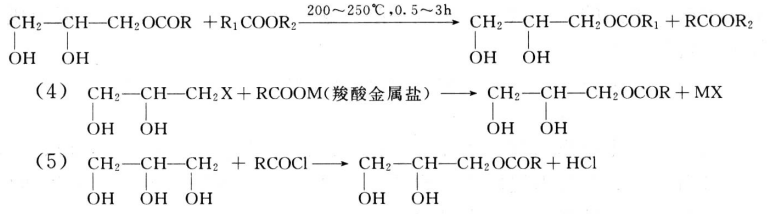
Organic esters of glycerol are the most common and widespread glycerol biotechnology. They can form esters with low carbonation and higher fatty acids. Because glycerol has three hydroxyl groups, it can react with fatty acids at different locations, so there are many varieties. There are mainly three kinds of esterification reaction of glycerol, that is, general alkyd esterification, alcoholysis and transesterification three kinds. In addition, there are reactions of glycerol halides with fatty acid salts and glycerol with acyl halides (or anhydrides) and so on (about fatty acid glycerides, the application of glycerol will be introduced in the chapter).

  1. Alkyd esterification is usually carried out under acid catalyst conditions. The reaction temperature is 200~230 C and the reaction time is about 3~8h.
  2. The alcoholysis reaction is usually carried out under alkaline conditions. The reaction temperature is about 100 C and the reaction time is about 0.5~3h.
  3. Lipid exchange reaction

    6.glycerol twelve acid (saturated or unsaturated)           alkyd resin
2.2.4  Sulfation reaction
At 10~20℃, sulphuric acid can react with glycerol to react with 2~4h.
2.2.5  Nitrification reaction
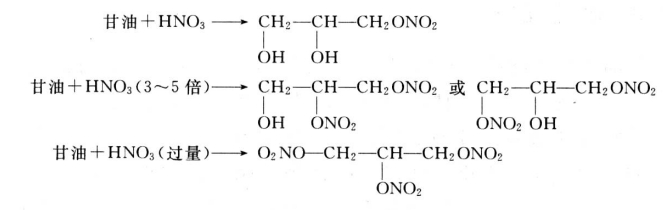
Glycerol reacts with dilute nitric acid or glycerol reacts with nitric acid to form a mixture of mononitro compounds or mononitro and dinitro compounds. Two nitro glycerin was produced when glycerol was acted on 3-5 times of nitric acid. Trinitro glycerin is produced when excessive nitric acid reacts with glycerol or when a mixture of sulfuric acid and nitric acid reacts with glycerol.

Thursday, September 20, 2018

Specific Heat of Liquids and Fluids

The specific heat for some commonly used liquids and fluids is given in the table below.
See also tabulated values of specific heat of gases, food and foodstuff,  metals and semimetals, common solids and other common substances as well as values of molar heat capacity of  common organic substances and inorganic substances.
ProductSpecific Heat  – c
(kJ/(kg K))(Btu/(lb oF))
(Kcal/kg oC)
Acetic acid2.0430.49
Acetone2.150.51
Alcohol, ethyl 32oF (ethanol)2.30.548
Alcohol, ethyl 104oF (ethanol)2.720.65
Alcohol, methyl. 40 – 50oF2.470.59
Alcohol, methyl. 60 – 70oF2.510.6
Alcohol, propyl2.370.57
Ammonia, 32oF4.61.1
Ammonia, 104oF4.861.16
Ammonia, 176oF5.41.29
Ammonia, 212oF6.21.48
Ammonia, 238oF6.741.61
Aniline2.180.514
Benzene, 60oF1.80.43
Benzene, 150oF1.920.46
Benzine2.1
Benzol1.80.43
Bismuth, 800oF0.150.0345
Bismuth, 1000oF0.1550.0369
Bismuth, 1400oF0.1650.0393
Bromine0.470.11
n-Butane, 32oF2.30.55
Calcium Chloride3.060.73
Carbon Disulfide0.9920.237
Carbon Tetrachloride0.8660.207
Castor Oil1.80.43
Chloroform1.050.251
Citron Oil1.840.44
Decane2.210.528
Diphenylamine1.930.46
Dodecane2.210.528
Dowtherm1.550.37
Ether2.210.528
Ethyl ether2.220.529
Ethylene glycol2.360.56
Dichlorodifluoromethane R-12 saturated -40oF0.880.211
Dichlorodifluoromethane R-12 saturated 0oF0.910.217
Dichlorodifluoromethane R-12 saturated 120oF1.020.244
Fuel Oil min.1.670.4
Fuel Oil max.2.090.5
Gasoline2.220.53
Glycerine2.430.576
Heptane2.240.535
Hexane2.260.54
Hydrochlor acid3.14
Iodine2.150.51
Kerosene2.010.48
Linseed Oil1.840.44
Light Oil, 60oF1.80.43
Light Oil, 300oF2.30.54
Mercury0.140.03
Methyl alcohol2.51
Milk3.930.94
Naphthalene1.720.41
Nitric acid1.72
Nitro benzole1.520.362
Octane2.150.51
Oil, Castor1.970.47
Oil, Olive1.970.47
Oil, mineral1.670.4
Oil, turpentine1.8
Oil, vegetable1.670.4
Olive oil1.970.47
Paraffin2.130.51
Perchlor ethylene0.905
Petroleum2.130.51
Petroleum ether1.76
Phenol1.430.34
Potassium hydrate3.680.88
Propane, 32oF2.40.576
Propylene2.850.68
Propylene Glycol2.50.60
Sesame oil1.630.39
Sodium, 200oF1.380.33
Sodium, 1000oF1.260.3
Sodium hydrate3.930.94
Soya bean oil1.970.47
Sulfuric acid concentrated1.38
Sulfuric acid1.34
Toluene1.720.41
Trichlor ethylene1.30
Tuluol1.510.36
Turpentine1.720.411
Water, fresh4.191
Water, sea 36oF3.930.938
Xylene1.720.41
  • 1 kJ/(kg K) = 1000 J/(kgoC) = 0.2389 kcal/(kg oC) = 0.2389 Btu/(lbm oF)
  • T(oC) = 5/9[T(oF) – 32]