Saturday, August 4, 2018

What are the main uses of vegetable glycerin?

What are the main uses of vegetable glycerin?

Glycerin is organic compounds that composed of carbon, hydrogen and oxygen , chemical formula is C3H8O3.It is an industrial product, usually soap, and by-product of fats and oils.In addition to animal fats, vegetable glycerol is processed from plants.In fact, raw materials do not affect the chemical properties of the final product, but because glycerol is widely used in food and medicine, this difference is important for vegetarians.Its common uses include food sweeteners and cosmetic ingredients.

Main uses of vegetable glycerin

Glycerin is widely used in the food industry for two main reasons.It absorbs moisture and absorbs moisture from the air.Therefore, it can be used in sweet foods and kept moist.This compound has a slower metabolism than sucrose, so it has no significant effect on blood sugar levels.It also does not promote bacteria to corrode teeth.Low-carb foods are often marketed as sweeteners.
Another major use of glycerin is the cosmetic industry.Because of its hygroscopic properties, it is often used in a variety of moisturizing skin products, because of the relief of dry skin.It is also a component of glycerol soap, suitable for sensitive skin.Vegetable glycerol can be used as a substitute for ethanol, a chemical commonly called alcohol.It is also used as a solvent for solvents for plant materials.
Vegetable glycerin also has some medical uses.For example, it is a common ingredient in cough suppressants because of its soothing effects.Other uses include topical remedies for skin diseases such as psoriasis, rashes, burns and bedsore wounds.As a laxative, it is a form of suppository.It can also be used to treat gum disease.

Friday, August 3, 2018

Where is the glycerin extracted?

The industrial production methods of glycerol can be divided into two categories:
The method of using natural oils and fats as raw materials, the obtained glycerin is commonly called natural glycerin;
In the synthesis method using propylene as a raw material, the obtained glycerin is commonly called synthetic glycerin.

1. Production of Natural Glycerin Prior to 1984, all glycerol was recovered from by-products of animal and vegetable fat soap. Until now, natural oils and fats are still the main raw material for the production of glycerin. About 42% of the natural glycerin in the base is made by the homemade soap by-product, and 58% is derived from the fatty acid production. Saponification of oils and fats in the soap making industry. The saponification reaction product is divided into two layers: the upper layer is mainly composed of fatty acid sodium salt (soap) and a small amount of glycerin, and the lower layer is waste alkali liquor, which is a dilute glycerin solution containing salt and sodium hydroxide, generally containing glycerin 9-16%, inorganic salt. 8-20%. Oil reaction. The glycerin water (also known as sweet water) obtained by hydrolysis of oil and fat has a glycerin content higher than that of the soap waste liquid, and is about 14-20%, and the inorganic salt is 0-0.2%. In recent years, continuous high pressure hydrolysis has been widely used. The reaction does not use a catalyst, and the obtained sweet water generally does not contain inorganic acid, and the purification method is simpler than the waste alkali solution. Whether it is soap waste liquid or glycerin water obtained by hydrolysis of oil, the amount of glycerin is not high, and all contain various impurities. The production process of natural glycerin includes purification, concentration to obtain crude glycerin, and distillation and decolorization of crude glycerin. Deodorization process. This process is described in detail in some books.
2. Production of Synthetic Glycerol The various routes for the synthesis of glycerol from propylene can be grouped into two broad categories, namely chlorination and oxidation. Propylene chlorination and propylene non-scheduled acetic acid oxidation are still used in the industry.
(1) Propylene Chlorination This is the most important production method for the synthesis of glycerol. It comprises four steps, namely high temperature chlorination of propylene, hypochlorochlorination of chloropropene, saponification of dichloropropanol and hydrolysis of epichlorohydrin. Hydrolysis of epichlorohydrin to glycerol is carried out in an aqueous solution of 10% hydrogen peroxide and 1% sodium carbonate at 150 ° C and 1.37 MPa carbon dioxide pressure to form a sodium chloride-containing glycerin aqueous solution having a glycerin content of 5-20%. After concentration, desalting, and distillation, glycerin having a purity of 98% or more is obtained.
(2) Propylene peracetic acid oxidation method Propylene and peracetic acid are used to synthesize propylene oxide, and propylene oxide is isomerized to a olefin. The latter is then reacted with peracetic acid to form glycidol (i.e., glycidol) and finally hydrolyzed to glycerol. The production of peracetic acid does not require a catalyst, and acetaldehyde and oxygen are vapor-phase oxidized. Under normal pressure, 150-160 ° C, and contact time of 24 s, the conversion of acetaldehyde is 11%, and the selectivity of peracetic acid is 83%. The latter two-step reaction described above is continuously carried out in a reaction column of a specific structure. After the raw material allyl alcohol and the ethyl acetate solution containing peracetic acid are sent to the column, the column is controlled at 60-70 ° C and 13-20 kPa. The ethyl acetate solvent and water were distilled off from the top of the column, and the column was stirred to obtain an aqueous glycerin solution. The method has high selectivity and yield, and uses peracetic acid as an oxidant, which can be used without a catalyst, and the reaction speed is fast, which simplifies the process. Production of 1t glycerol consumed 1.001t of allyl alcohol, 1.184t of peracetic acid, and 0.947t of by-product acetic acid. At present, the production of natural glycerin and synthetic glycerol accounts for almost 50% each, while the propylene chlorination method accounts for about 80% of the production of Healing glycerol. China's natural glycerin accounts for more than 90% of total production.

Thursday, August 2, 2018

Glycerine market: lack of interdependence between supply and demand

Glycerine, also known as glycerol, is a water-soluble liquid with sweet taste. It is colourless, odourless and viscous. It is a by-product of two independent processes: hydrolysis and transesterification. The former is used for soap and fatty acid production while the latter is the process in which biodiesel is produced.
The usual production rate is 10% of glycerine per unit of biodiesel. What comes out of the transesterification process is, so called, crude glycerine with 40-90% of glycerine content. This by-product is then refined to increase the content of glycerine to 99.5% or 99.7%. There are three grades of refined glycerine on the market: technical one, used in the production of chemicals but not intended for human consumption, USP (United States Pharmacopeia) grade which is suitable for use in food or pharmaceuticals and Kosher grade glycerine, coming from plant oil sources and thus suitable for kosher food production.
A RELATIVELY YOUNG MARKET
2004 is a turning point for the glycerine market due to the, so called, “first biodiesel revolution.” Since that time, together with the fast development of the biodiesel industry, the esterification process became the main source for glycerine. Today, around 66% of world’s glycerine supply comes from biodiesel production. Before 2004 the main source of glycerine was hydrolysis used for soap and fatty acid production.
The year 2010 brought what we call the “second biodiesel revolution,” which popularized waste-based biodiesel. Yet, it also influenced the quality of the crude glycerine available on the market as both the nature of raw material used in biodiesel production as well as the catalyst for the esterification process have impact on the purity of glycerol. Typically, the by-product of the waste-based biodiesel production has lower quality with glycerol content between 60-75%. However, today, there is a number of UCOME and TME plants whose by-product has 80% glycerol content.
Due to the rapid development of the biodiesel market, the production volume of glycerine more than doubled during the last 10 years causing misbalances between supply and demand. More glycerine was produced than the market could absorb and there was an urgent need for new uses for this by-product. However, with the growing number of possible applications, the demand for glycerine started to go up, outgrowing, in the last few months, the current supply.
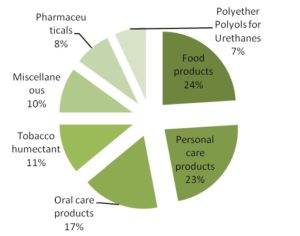
glycerine article
Graph 1: End use of refined glycerine worldwide

Moreover, the improvement in the life standard in certain regions of the world, especially in the South-East Asia, continuously increases the demand for glycerine. In China and India the ever growing demand for medicines and personal care products is putting pressure on the refined glycerine market.
MARKET OVERVIEW
The main characteristic of the glycerine market is the lack of interdependence between supply and demand. As glycerine is a by-product, its supply is mainly dependent on the performance of the biodiesel market. Thus, bigger demand for glycerine does not result in bigger supply The supply increases only when the demand for biodiesel goes up.
As a result, the price of crude glycerine is strongly dependent on the current supply levels making the market very volatile. Historically the price of glycerine was always low due to oversupply, however, with the discovery of new applications and expansion of the market, the demand started to grow allowing the prices to recover. Currently, the demand from developed countries as well as from developing regions, especially, South-East Asia is pushing the prices further up. It is difficult to predict whether the growth of the biodiesel market will go hand in hand with the increase of glycerine demand. It makes it even more difficult to forecast what will be the development of the price trend in the short term, let alone in the long term perspective. What is sure, though, is that it will be determined by the situation on the biodiesel market, predominantly in Europe and in Asia.
It is estimated that the current worldwide production of glycerine is 2.9 million tons per year. This estimation takes into account all possible sources. In 2015 in Europe, around 810,000 tons of glycerin has been produced from veg-oils and around 150,000 tons of glycerine has come from the UCOME and waste fatty acid biodiesel production. In addition, another 45,000 MT should come from processing animal fats of category 1 and 2 into biodiesel. However, it has to be noted that glycerol originating from waste-based biodiesel production can only be used for technical purposes and cannot undergo the refining process to USB grade, only to technical grade. The size of the refined glycerine market is estimated at 2 million metric tons in 2015 but it is growing rapidly as pharmaceuticals and personal care are the fastest growing demand sectors.
More than 55% of the world’s demand for crude glycerine comes from two regions: Europe and South-East Asia. While Europe is the biggest buyer of crude glycerine, Asia is the biggest producer and consumer of refined glycerine, using approximately 35% of world’s supply. Europe consumes 28% of refined glycerine produced annually in the world and North America around 19%.
Even though the glycerine market is small, compared to the biodiesel market, for example, it is global and interconnected making it vulnerable to shocks in international biodiesel production.
FOCUS ON ASIA
Next to Europe and North America, the countries of South-East Asia are the key players on today’s glycerine market. The interest comes predominantly from China and India where the rapidly changing economies contribute to a steady increase in the standard of living. This, in turn, influences the growth of demand for personal care products and medicines which are produced with the use of refined glycerine. Thus the demand for glycerine is increasing but the local supply cannot keep up.
South-East Asian countries usually import crude glycerine and refine it locally as most of the glycerine consumed in this region is refined. In 2014, China imported 795,000 MT of crude glycerine and 164,000 MT of refined glycerine. At the same time, export reached mere 3,550 MT of refined product. The imported volumes increased by 30% between 2013 and 2014. Last year, the total consumption of refined glycerine in China accounted for 918,000 MT and is predicted to grow further in 2015.
The glycerine imported to Asia comes mainly from European and Argentinean biodiesel producers while 60-70% of the local supply is also a by-product of the esterification process. Due to recent changes in the Indonesian biodiesel policy introducing subsidies for biodiesel producers, the country might become an interesting glycerine supplier for China or India. It is difficult, though, to estimate the possible volumes that might be added to the market as a result of these legislation changes. Definitely, this will not be enough to satiate the ever growing demand for glycerine in this rapidly developing part of the world.
FUTURE OUTLOOK
The world glycerine market keeps growing in two separate directions. First of all, new applications for glycerol are constantly being invented, making it a highly desired product: currently the number of glycerine uses reaches 2,000. Secondly, new geographical markets for glycerol appear due to the fact that new developing countries experience improvement in life standards of their citizens. As a result, the demand for products including glycerine is increasing. It is estimated that the total growth of the glycerine market between 2011 and 2018 should account for 6.3%.
The key question that remains is whether the supply will keep up with the increasing need for glycerine given its independence from demand. This will be determined solely by the development of the biodiesel industry and the legislative support for biodiesel production in countries that are new to this industry.
It is also interesting to note that the popularization of HVO will not help to ease the situation on the glycerine market as the production process of green diesel does not result in glycerol as by-product. Thus, if the biodiesel mandates do not increase in the future HVO production might even have a negative impact on the glycerine market. It is connected with the promotion of waste-based biofuels at the expense of first generation biodiesel production. However, with the HVO sector constituting still a relatively small percentage of the regular biodiesel market, this should not be considered as a realistic threat for the glycerine supply, at least in the next few years.
The forecasted development of the biodiesel production in Asia or Argentina should help to balance the supply and demand on the glycerine market in the future. At the same time, it should contribute to the further expansion of the personal care and pharmaceutical uses of glycerol and the availability of such products in the developing regions.

Wednesday, August 1, 2018

Ion exchange refined glycerin

The crude glycerin is distilled, deodorized, and decolored, and good quality industrial glycerin products can be obtained. However, some indicators such as reducing substances, acrolein, and color do not meet the requirements of certain industries. In order to obtain high quality glycerin products (such as medicinal glycerin, explosive glycerin, reagent grade glycerin, etc.), the method adopted in the 1950s was secondary distillation.
In 1850, the phenomenon of ion exchange was discovered, and it was applied in industry and after 60 years. In the late 1960s, with the development of synthetic resin technology, China developed a method for purifying trace impurities in glycerol after deodorization and decolorization using ion exchange resin technology.
Ion exchange resin
The ion exchange resin refers to a resin in which a reactive group in a resin molecule can be ion-exchanged with other substances. Most of them are copolymers of styrene and divinylbenzene. The ion exchange resin is classified into a cation exchange resin and an anion exchange resin depending on the nature of the acidic group or the basic group in the molecule. According to the difference in acidity or alkalinity, the ion exchange resin is divided into strong acidity (sulfonic acid group-SO3H in the molecule), medium acidity (phosphoric acid group-H2PO in the molecule, phosphonic acid group-H2PO3), weak acidity ( The molecule contains a carboxylic acid group – COOH, etc.), strongly basic [containing quaternary ammonium-N(CH3)3OH in the molecule], moderately basic [tetraethylenepentamine-H(HNCH2CH2)4NH2 in the molecule] and weak base Sex (m-phenylenediamine formaldehyde resin, etc.) and numbered separately. Among them, the degree of cross-linking is marked after the number. For example, a sulfonic acid type cation exchange resin containing 12% (i.e., degree of crosslinking) of divinylbenzene is referred to as 1X12.
The ion exchange resin is typically a particulate or spherical solid. It does not dissolve in acids, bases or their salts and other common solvents, only swelling. When it comes into contact with a solution containing an ion, ion exchange occurs, so that the ion in the solution can be removed. Its performance is gradually lost as the amount of exchange increases, and this exchange capability can be regenerated by processing.
The resins which can be used for glycerin purification are styrene strong acid type cation exchange resin, sulfonated coal resin, styrene quaternary ammonium salt strong base type exchange resin, and phenol formaldehyde weak base type resin. A styrene strong acid type cation exchange resin and a sulfonated coal resin can remove cations such as Na+, Mg2+, and Fe3+. The styrene quaternary ammonium salt strong base type exchange resin can remove anions such as CO3, SiO, formic acid, phenol, and fatty acid. The phenol formaldehyde weak base resin can remove strong acid ions such as CI-, sO?-, and PO3-. Large particle adsorption resins (such as X54-1) are mainly used for adsorption decolorization.

The structure and character of Glycerol

Glycerin is a organic compounds that made up of  Carbon hydrogen oxygen .This organic compound is made up of three chains of carbon atoms that connect hydrogen on one side and hydroxyl (OH) on the other..Three hydroxyl groups form hydrogen bonds between molecules, which make the syrup of the compound sticky and more easy to  soluble in water …On the point of chemical ,glycerol is an alcohol, but it is not intended for edible . It is classified by the food and drug administration in the United States as a carbohydrate because it provides calories and is not fat or protein. Pure glycerol does not crystallize easily, but it cools to form a solid and melts at 18 ℃ It reduces the freezing point of water, and the effect will depends on the concentration.For example, 66.7% of a solution has a freezing point of -46.1 ℃ For this reason, it can be used as a non-toxic antifreeze and it is used as store of sensitive liquids such as enzymes in laboratory refrigerators.
The production and processing of glycerin
Glycerol forms the skeleton of many lipids, oils, or fats, and there are many ways to extract it from these substances ,Most glycerol is processed from the by-products of soap production ,Animal fats or vegetable oils can be used in the process.It is heated with a strong alkali , usually caustic soda (sodium hydroxide), which produces soap and glycerine solutions in water.The solution is then distilled by distillation.
Vegetable glycerine can be produced directly from vegetable oil, often coconut oil or palm oil, heated at high temperatures under water pressure.The glycerol skeleton is separated from fatty acids, absorbed by water, then isolated and distilled to extract pure products.food grade vegetable oils are 99.7% pure and the remaining 0.3% is water.
Interest in biodiesel fuels has led to the production of large amounts of non-edible vegetable glycerin.It is not cost-effective to purify the liquid and cannot be disposed randomly as it contains toxic methanol.In 2013, there was a lot of research looking for the use for the substance, and one study found that it could be used to make useful plastics.

What are the differences between Crude Glycerin, Technical Grade Glycerin, and 99.7 - USP Grade Glycerin?

With the domestic crude glycerin market reaching its saturation point and the prices of crude glycerin currently at an all time low, glycerin purification will no longer be an option for biodiesel plants but rather more of a business necessity. Further purification and refinement of crude glycerin, increases it's market value thus making it more appealing to potential buyers. Unlike many of our competitor's biodiesel process equipment, glycerin refining system will produce technical grade glycerin (>97% purity) as opposed to the average in the biodiesel industry which ranges between an 80 and 90% purity range.
Properties Crude Glycerin Technical Grade Glycerin 99.7 -USP Grade Glycerin
Glycerol Content 40 - 88% 98.0 Min 99.70%
Ash 2.0% Max N/A N/A
Moisture Content N/A 2.0% Max 0.3% Max
Chlorides N/A 10 ppm Max 10 ppm Max
Color N/A 40 Max (Pt - Co) 10 Max. (APHA)
Specific Gravity N/A 1.262 (@25C) 1.2612 Min
Sulfate N/A N/A 20 ppm Max
Assay N/A N/A 99.0 - 101.0% (on dry basis)
Heavy Metals N/A 5 ppm Max 5 ppm Max
Chlorinated Compounds N/A 30 ppm Max 30 ppm Max
Residue on Ignition N/A N/A 100 ppm Max
Fatty Acid & Ester N/A 1.00 Max 1.000 Max
Water 12.0% Max 5.0% Max 0.5% Max
pH (10% Solution) 4.0 - 9.0 4.0 - 9.1 N/A
DEG and Related Compounds   N/A   N/A   Pass
Organic Volatile Impurities N/A N/A Pass
Organic Residue 2.0% Max 2.0% Max N/A
 

What are the differences between Crude Glycerin, Technical Grade Glycerin, and 99.7 - USP Grade Glycerin?

  Crude Glycerin - Crude glycerin contains a significant amount of methanol, water, soaps, and salts and typically has a glycerol content of anywhere between 40 to 88%. Crude glycerol is a natural by-product produced during the biodiesel production process, specifically taking place during transesterification. Technical Grade Glycerin - Technical grade glycerin is a refined, high-purity product that is water white with most of its contaminants completely  removed. Technical grade glycerin contains no methanol, soaps, salts, and other foreign matter.  USP Grade Glycerin - USP Grade Glycerin is a pharmaceutical grade glycerin suitable for food, personal care, cosmetics, pharmaceuticals, and other specialty applications. All of these products have met the US Pharmacopeia specifications (USP 30). PLEASE NOTE: Be leery of any company claiming to produce USP Grade glycerin as these companies MUST be registered and controlled by the FDA. Many companies make false claims of producing USP grade glycerin when in fact, they cannot and should not make such claims without being governed by the Federal Government.

What classifies glycerin as USP Grade?

To be called USP Grade Glycerin companies are closely regulated with regards to their manufacturing facility, testing methods, inspections, distribution, and warehousing. True USP Grade Glycerin follows strict rules and guidelines set forth by the FDA. The FDA requires that all domestic companies distributing USP Grade Glycerin must be registered and listed unless they qualify for exemption. The same applies for USP Glycerin originating from a foreign manufacturing facility going to an importer in the states. In this instance, FDA compliance by both parties is still a requirement. FDA regulations also require systematic and complete record keeping by all USP glycerin manufacturers. They must have supporting documentation at all times for every shipment providing lot numbers and permits tracing back to the plant it was produced in. USP Grade Glycerin assures buyers of the product's integrity which cannot be achieving through physical and chemical testing alone. On the flip side, Technical Grade Glycerin is not subject to such governmental regulatory control. Although produced by similar processes, Technical Grade Glycerin does not need to comply with USP and FCC requirements or FDA regulations. This grade of glycerin only needs to conform to the specifications mutually agreed upon by the buyer and seller.

production method of glycerin

The industrial production methods of glycerin can be divided into two major categories: the method of using natural oils and fats as raw materials, the obtained glycerin is commonly called natural glycerin, and the synthetic method of using propylene as raw material, the obtained glycerin is commonly called synthetic glycerin.
Prior to 1984, glycerol was recovered from by-products of animal and vegetable fat soaps. So far, natural oils and fats are still the main raw material for the production of glycerin, of which about 42% of natural glycerin is made by-product soap and 58% is derived from fatty acid production. Saponification of oils and fats in the soap making industry. The saponification reaction product is divided into two layers: the upper layer is mainly composed of fatty acid sodium salt (soap) and a small amount of glycerin, and the lower layer is waste alkali liquor, which is a dilute glycerin solution containing salt and sodium hydroxide, generally containing glycerin 9-16%, inorganic salt. 8-20%. Oil reaction.The glycerin water (also known as sweet water) obtained by hydrolysis of oil and fat has a glycerin content higher than that of the soap waste liquid,and is about 14-20%, and the inorganic salt is 0-0.2%. In recent years, continuous high pressure hydrolysis has been widely used. The reaction does not use a catalyst, and the obtained sweet water generally does not contain inorganic acid , and the purification method is simpler than the waste alkali solution. Whether it is soap waste liquid or glycerin water obtained by hydrolysis of oil, the amount of glycerin is not high, and all contain various impurities. The production process of natural glycerin includes purification , concentration to obtain crude glycerin, and distillation and decolorization of crude glycerin. Deodorization process. This process is described in detail in some books.and is about 14-20%, and the inorganic salt is 0-0.2%. In recent years, continuous high pressure hydrolysis has been widely used.The reaction does not use a catalyst, and the obtained sweet water generally does not contain inorganic acid , and the purification method is simpler than the waste alkali solution. Whether it is soap waste liquid or glycerin water obtained by hydrolysis of oil, the amount of glycerin is not high, and all contain various impurities. The production process of natural glycerin includes purification , concentration to obtain crude glycerin, and distillation and decolorization of crude glycerin. Deodorization process. This process is described in detail in some books.and is about 14-20%, and the inorganic salt is 0-0.2%. In recent years, continuous high pressure hydrolysis has been widely used. The reaction does not use a catalyst, and the obtained sweet water generally does not contain inorganic acid ,and the purification method is simpler than the waste alkali solution. Whether it is soap waste liquid or glycerin water obtained by hydrolysis of oil, the amount of glycerin is not high, and all contain various impurities. The production process of natural glycerin includes purification , concentration to obtain crude glycerin, and distillation and decolorization of crude glycerin. Deodorization process. This process is described in detail in some books.and the obtained sweet water generally does not contain inorganic acid, and the purification method is simpler than the waste alkali solution . Whether it is soap waste liquid or glycerin water obtained by hydrolysis of oil, the amount of glycerin is not high, and all contain various impurities. The production process of natural glycerin includes purification,concentration to obtain crude glycerin, and distillation and decolorization of crude glycerin. Deodorization process. This process is described in detail in some books.and the obtained sweet water generally does not contain inorganic acid, and the purification method is simpler than the waste alkali solution . Whether it is soap waste liquid or glycerin water obtained by hydrolysis of oil, the amount of glycerin is not high, and all contain various impurities. The production process of natural glycerin includes purification, concentration to obtain crude glycerin, and distillation and decolorization of crude glycerin. Deodorization process. This process is described in detail in some books.The production process of natural glycerin includes purification, concentration to obtain crude glycerin, and distillation and decolorization of crude glycerin.Deodorization process. This process is described in detail in some books.The production process of natural glycerin includes purification, concentration to obtain crude glycerin, and distillation and decolorization of crude glycerin. Deodorization process. This process is described in detail in some books.
The various routes for the synthesis of glycerol from propylene can be grouped into two broad categories, namely chlorination and oxidation. Propylene chlorination and propylene non-scheduled acetic acid oxidation are still used in the industry.
Propylene chlorination
This is the most important production method for the synthesis of glycerol. It consists of four steps, namely high temperature chlorination of propylene, hypochlorochlorination of chloropropene, saponification of dichloropropanol and hydrolysis of epichlorohydrin. Hydrolysis of epichlorohydrin to glycerol is carried out in an aqueous solution of 10% hydrogen peroxide and 1% sodium carbonate at 150 ° C and 1.37 MPa carbon dioxide pressure to form a sodium chloride-containing glycerin aqueous solution having a glycerin content of 5-20%. After concentration, desalting, and distillation, glycerin having a purity of 98% or more is obtained.
Propylene peracetic acid oxidation
Propylene reacts with peracetic acid to synthesize propylene oxide, and propylene oxide is isomerized to alkene. The latter is then reacted with peracetic acid to form glycidol (ie, glycidol) and finally hydrolyzed to glycerol. The production of peracetic acid does not require a catalyst , and acetaldehyde and oxygen are vapor-phase oxidized. Under normal pressure, 150-160 ° C, and contact time of 24 s, the conversion of acetaldehyde is 11%, and the selectivity of peracetic acid is 83%. The latter two- step reaction described above is continuously carried out in a reaction column of a specific structure. After the raw material allyl alcohol and the ethyl acetate solution containing peracetic acid are sent to the column, the column is controlled at 60-70 ° C and 13- 20 kPa.The ethyl acetate solvent and water were distilled off from the top of the column, and the column was stirred to obtain an aqueous glycerin solution. The method has high selectivity and yield, and uses peracetic acid as an oxidant, which can be used without a catalyst, and the reaction speed is fast, which simplifies the process. Production of 1t glycerol consumed 1.001t of allyl alcohol, 1.184t of peracetic acid, and 0.947t of by-product acetic acid. At present, the production of natural glycerin and synthetic glycerol accounts for almost 50% each, while the propylene chlorination method accounts for about 80% of the production of Healing glycerol. China’s natural glycerin accounts for more than 90% of total production.and uses peracetic acid as an oxidant, which can be used without a catalyst, and the reaction speed is fast,which simplifies the process. Production of 1t glycerol consumed 1.001t of allyl alcohol, 1.184t of peracetic acid, and 0.947t of by -product acetic acid. At present, the production of natural glycerin and synthetic glycerol accounts for almost 50% each, while the propylene chlorination method accounts for about 80% of the production of Healing glycerol. China’s natural glycerin accounts for more than 90% of total production.and uses peracetic acid as an oxidant, which can be used without a catalyst, and the reaction speed is fast, which simplifies the process. Production of 1t glycerol consumed 1.001t of allyl alcohol, 1.184t of peracetic acid, and 0.947t of by -product acetic acid. At present, the production of natural glycerin and synthetic glycerol accounts for almost 50 % each,while the propylene chlorination method accounts for about 80% of the production of Healing glycerol. China’s natural glycerin accounts for more than 90% of total production.the production of natural glycerin and synthetic glycerol accounts for almost 50% each, while the propylene chlorination method accounts for about 80% of the production of Healing glycerol. China’s natural glycerin accounts for more than 90% of total production.the production of natural glycerin and synthetic glycerol accounts for almost 50% each, while the propylene chlorination method accounts for about 80% of the production of Healing glycerol. China’s natural glycerin accounts for more than 90% of total production.the production of natural glycerin and synthetic glycerol accounts for almost 50% each, while the propylene chlorination method accounts for about 80% of the production of Healing glycerol. China’s natural glycerin accounts for more than 90% of total production.the production of natural glycerin and synthetic glycerol accounts for almost 50% each, while the propylene chlorination method accounts for about 80% of the production of Healing glycerol. China’s natural glycerin accounts for more than 90% of total production.the production of natural glycerin and synthetic glycerol accounts for almost 50% each, while the propylene chlorination method accounts for about 80% of the production of Healing glycerol. China’s natural glycerin accounts for more than 90% of total production.the production of natural glycerin and synthetic glycerol accounts for almost 50% each, while the propylene chlorination method accounts for about 80% of the production of Healing glycerol. China’s natural glycerin accounts for more than 90% of total production.while the propylene chlorination method accounts for about 80% of the production of Healing glycerol. China’s natural glycerin accounts for more than 90% of total production.while the propylene chlorination method accounts for about 80% of the production of Healing glycerol. China’s natural glycerin accounts for more than 90% of total production.
Industrial grade glycerin
The amount of industrial grade glycerin is diluted with 1/2 amount of distilled water. After stirring, the activated carbon is added and heated to 60-70 ° C for decolorization treatment, and then vacuum filtered to ensure the filtrate is clear and transparent. The dropping rate is controlled, and the filtrate is added to a column of a previously prepared 732 type strong acid cation resin and a 717 type strong base yin and yang resin to adsorb and remove the electrolyte and aldehydes, pigments, esters and the like in the glycerin.