Monday, August 13, 2018

Global Oleochemicals Fatty Acids Market expected to reach $30.62 billion by 2022

The Global Oleochemicals Fatty Acids Market is valued at $16.4 billion and is expected to reach $30.62 billion by 2022 growing at a CAGR of 8.1% from 2014 and 2022. Some of the key drivers of the market include consumer-driven demand and recyclability. Whereas demand for food & beverages, soaps & detergents acts as opportunities for the market growth. Exposure to consumer trends is favoring markets such as cleaning, beauty and food.
Asia-Pacific held the largest share in 2013, China being the top contributor. Japan, China and India are the prominent countries with a huge demand for oleochemicals. Growing applications of oleochemicals in the soaps & detergents industry is boosting investments in the oleochemicals market. The demand for oleochemicals is rising in the pharmaceutical & personal care industry as consumers are becoming conscious about the environmental benefits and cost effectiveness offered by oleochemicals. Significant mergers and acquisitions, collaborations, and joint ventures are the industry trends that are playing a major role for the market growth.
Oleochemicals fatty acids market is segmented by product, by application and by geography. Depending on the products, the market is segmented into distilled fatty acids, stearic acid, polyunsaturated fatty acids, fractionated fatty acids, glycerin and fatty alcohols. Based on applications, market is categorized into food and beverages, pharmaceuticals and personal care, polymers, soaps and detergents. By geography, the market is segmented into North America, Europe, Asia-Pacific and Rest of the World.

Saturday, August 11, 2018

Glycerin’s relative density

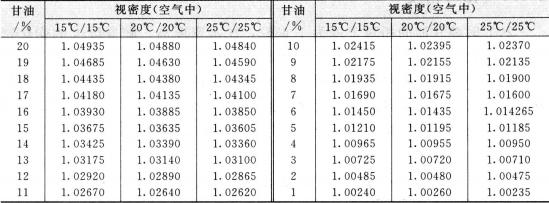
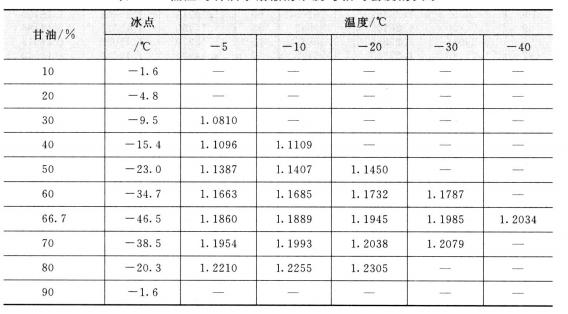
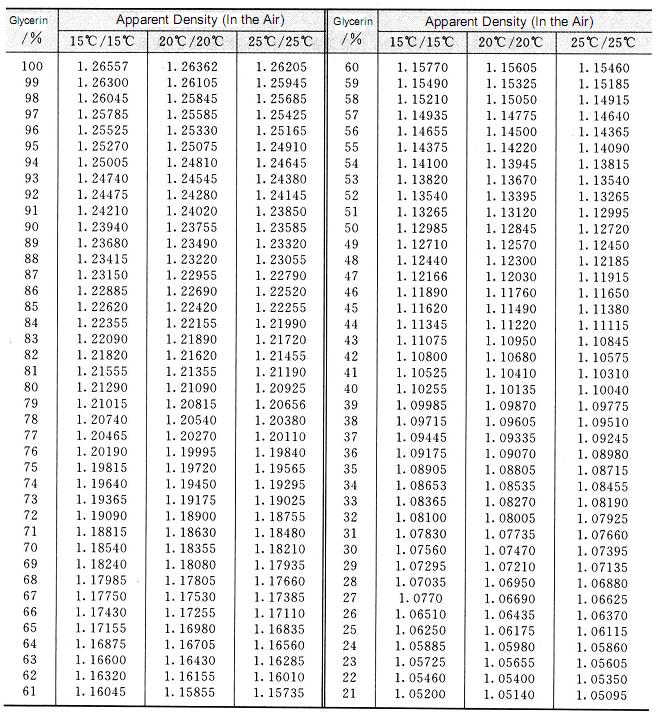
The relative density of pure glycerin at 20°c is 1.6362, which is higher than water density. The density changes as the change of temperature. The temperature increases and the relative density decreases. The relative density of glycerin aqueous solution increases with the increase of glycerin content, so the purity of glycerin can be determined by relative density. The result is quite exact. So the method is widely used as the method of determination of glycerin concentration. The conversion relation between the relative density and the concentration of glycerin aqueous solution refers to table 2. 2. the relationship between the concentration of glycerol aqueous solution and the relative density at low temperature is shown in table 2.3.
Table 2.2 Conversion relationship between relative density and concentration of glycerin aqueous solution
Continued Table
Table 2.3 The relationship between concentration and relative density of glycerol aqueous solution at low temperature
2.1.2 Glycerin’s Viscosity
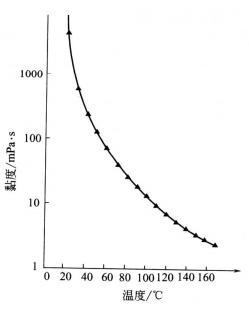
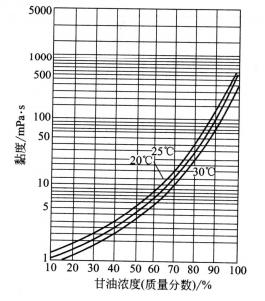
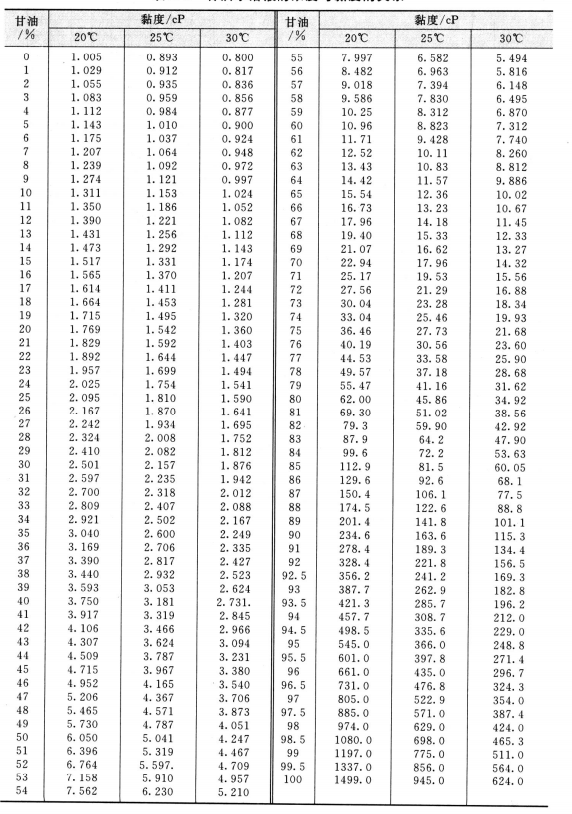
Glycerin’s viscosity is very high, which is a very prominent characteristic of glycerin. The viscosity varies with the temperature, the temperature increases, and the viscosity decreases (see figure 2.2). At a certain temperature, the viscosity of the oil-water solution increased with the increase of glycerin concentration (see Figure 2.3).
When there is moisture in the glycerol, the viscosity calculation formula is as follows:
Lg η=l. 9367-2. 700X 10³/T+0. 90X 10^6/T^2-0. 043c
In the formula, η is water containing c*% (mass) and the dynamic viscosity (freezing point = 273.16K)  when the thermodynamic temperature is T.
In addition, glycerin’s viscosity increases rapidly with the increase of pressure, as well as its growth rate. If the Lg η/P and P mapping, it almost forms into a straight line relationship ( η=30°c and  the viscosity of glycerin under Latm❶, p = pressure)
2.2 The relationship between viscosity and temperature of pure glycerin
2.3 The relationship between glycerin concentration and viscosity
Electrolyte in pure glycerin and glycerin aqueous solution, usually increases the viscosity of glycerol, but there are also exceptions, such as ammonium chloride, ammonium bromide, ammonium iodide, rubidium chloride and bromide, nitrate etc. The higher concentration of these salts, the higher the concentration of glycerin, the lower viscosity.

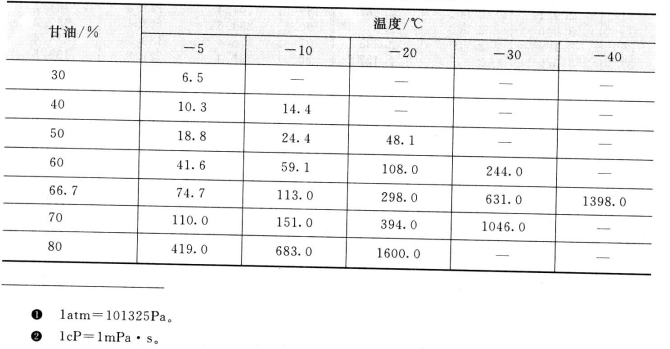
The viscosity of glycerin aqueous solution at low temperature (CP) and the concentration and viscosity of glycerol aqueous solution are shown in table 2. 4, Table 2.5.

2.4 Viscosity of glycerol water concentration at low temperature/cP
2.5 The relationship between concentration and viscosity of glycerin aqueous solution

Friday, August 10, 2018

Analysis of factors affecting the quality of glycerine products

The quality problems of glycerol mainly including the smell of burnt, yellow color unqualified saponification equivalent,acrolein and reducing substances exceed the standard,chlorides, ash and carboniferous substances exceed regulations.There are several reasons for these problems as below.
  1. Oil: low grade oil generally refers to thespoiled oil or oil with impurities due to improper storage and all kinds of recovered oil.The organic components are oxidized and deteriorated due to high amount of oxidized fatty acids, low carbon fatty acids, aldehyde, ketone, protein and other impurities, or due to the processing of saponified waste liquid, long-term storage time and dirty container.These substances are dissolved in saponified waste liquid and not easily removed during treatment.As a result, the crude glycerine has a dark color and heavy taste, distilled refined glycerol has a smell, yellow color or unstable color.For this reason, during the distillation operation, the material should not stay in the distillation kettle for a long time, the level should not be too high, the level fluctuation should not be too big, the vacuum degree should not be too low.Low grade oil should be properly pretreated or treated separately.For the production of pharmaceutical grade glycerol and explosive glycerol, the variety and quality of oil must be selected and controlled.Experience has shown that, in addition to castor oil, fish oil, ash seed oil, silkworm pupa oil saponification waste liquid should not produce explosive glycerin, rice bran oil, cottonseed oil should also be used with caution.
  2. Low molecular fatty acid: when saponified waste liquid or sweet water is purified, low molecular fatty acid (salt) enters purified water and then enters crude glycerol.During distillation, organic salts are broken down and free fatty acids are esterified by glycerol vapour in the gas phase, resulting in high esters of refined glycerol.In addition, the presence of protein and magnesium salts in crude glycerol may increase the ester content of refined glycerol.Therefore, a certain alkalinity of crude glycerol can be properly controlled during distillation.(0.1%~0.2%)The other way around, when cleaning saponified waste liquid or sweet water, the fatty acids should be removed as much as possible.
  3. Operating conditions: low vacuum high temperature or local overheating under vacuum can increase the amount of acrolein,the liquid level overflows and the vacuum fluctuates too much,entrainment of fog and foam enters into condenser due to the imperfect vapor phase separation device,which result in the index of fine glycerol chloride, ash, readily carbonizable substance to be unqualified.In addition, equipment leakage should be prevented during operation.
  4. The dark color and strong smell of the stewed glycerine should be separated from the normal stewed glycerine, which should be combined with crude glycerol.

Thursday, August 9, 2018

Refining glycerine applications

This colourless and odorless, sweet-tasting viscous liquid and it is hygroscopic.
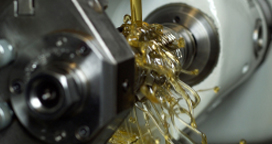
End-use applications for Glycerine include pharmaceutical applications, food and beverage ingredient, sweetener, Personal care items such as tooth pastes, cosmetics, soaps, polyether polyols, alkyd resins, explosives, humectants, coatings, Pet foods, lubricants, flexible foams, solid fuel, de-/anti-icers, paints, textiles, surface coating, paper and printing industry, plastics, daily chemicals, agricultural, toiletries, tobacco, rubber, lubricants , PU Forms, as good additive and many more industries.
Pharmaceutical & Drug
  • Used in medical and pharmaceutical preparations, mainly as a means of improving smoothness, provide lubrication and humectants
  • Suppositories, cough syrups, elixirs and expectorants
Personal Care & Cosmetics
  • Serves as an emollient, humectants, solvent, and lubricant in personal care products.
  • Competes with sorbitol although glycerol has better taste and higher solubility.
  • Toothpaste, mouthwashes, skin care products, shaving cream, hair care products and soaps.
Food and Beverages
  • Serves as humectant, solvent and sweetener, may help preserve foods
  • Solvent for flavours and food colouring
  • Humectant and softening agent in candy, cakes and casings for meats and cheeses
  • Manufacture of mono- and di-glycerides for use as emulsifiers
  • Used in manufacture of polyglycerol esters going into shortenings and margarine
  • Used as filler in low-fat food products (i.e., cookies)
Polyether Polyols
  • One of the major raw materials for the manufacture of polios for flexible foams, and to a lesser extent rigid polyurethane foams
  • Glycerol is the initiator to which propylene oxide/ethylene oxide is added
Alkyed Resins ( Plastics ) and Cellophane
  • Used in surface coatings and paints
  • Used as a softener and plasticizer to impart flexibility, pliability and toughness
  • Uses include meat casings, collagen casings (medical applications)and nonmeat packaging
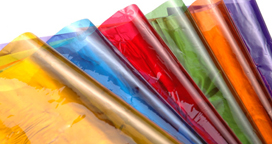
  • Plasticizer in cellophane.
Explosives
  • Used in the production of TNT (trinitroglycerine)
  • Glyceryl triacetate is a component in binders in the production of solid fuel rockets
Other
  • Manufacture of paper as a plasticizer, humectants and lubricant
  • Humectants for pet foods to retain moisture and enhance palatability
  • Used in lubricating, sizing and softening of yarn and fabric
  • Used in de-/anti-icing fluids
  • Patent applications have been filed for detergent softeners and surfactants based on glycerine (i.e., alkyl
    glyceryl ethers) instead of quaternary ammonium compounds

Wednesday, August 8, 2018

Classification of glycerol and definitions of industrial glycerin, medical glycerin, crude glycerin, etc.

Glycerin can be classified into natural glycerin which is derived from natural oils and fats, also called saponified glycerin, and synthetic glycerin which uses propylene as a raw material, depending on the production method. Compared with other glycerol, saponified glycerol has better quality and has a wide range of uses.
1. Used as an anti-coolant for aircraft and automotive liquid fuels
2. Used as a brightener for cellophane in the paper industry and as a plasticizer in the production of coated paper.
3. As a raw material for surfactants, toothpaste, an important moisturizer for cosmetics
4. Moisture absorbers for leather, textiles, etc., humectants for keeping tobacco in cigarettes
5. Edible flavors, raw materials for plasticizers
6. For the manufacture of glyceryl trinitrate smokeless powder, nitroglycerol acid resin and ester glue.
Industryuse
Food industrylubricants, sweeteners, solvents (fragrance, pigment), preparation of monoglycerides, polyglycerides (emulsifiers, margarines), moisturizers (pet foods), flavor enhancers
Pharmaceutical industryWetting agents, lubricants, solvents, smoothing agents, expectorants, cough syrup, etc
Cosmetic IndustryToothpaste, Sukou, Skin Care, Plasticizer
Coating (alkyd resin)cellophane production, softener, plasticizer
Tobacco IndustryTriacetin, Adhesive, Plasticizer
Explosive industryDigestive agent for digesting glycerin and solid rocket fuel
Polyurethane IndustryOne of the main raw materials for flexible polyurethane foams, propylene oxide / epoxy resin addition
In the textile industryinitiators, water-absorbent resins, etc., cotton yarn, cloth lubricant, sizing, soft
Paper industrywetting agent, plasticizer
The specific classification of glycerin is: industrial grade, cosmetic grade, food grade, pharmaceutical grade (sub-drug supplement and drug master), four grades.
The industrial grade usually refers to the second-class glycerin in GB 13206. The 95% pharmaceutical grade glycerin requires relatively high impurities in glycerin, has a limit requirement of diethylene glycol and ethylene glycol, and requires GMP certificate for the production of pharmaceutical grade glycerin. Food grade glycerin standards are currently a bit fuzzy, usually using GB13206
Crude glycerol generally refers to glycerol having a glycerin content of less than 93%. It is generally used to refine high-purity glycerol such as 95%, 98% and 99.5%. Refined glycerin is a general term and is classified into saponified glycerin, hydrolyzed glycerin and refined glycerin depending on the source of refined glycerin. Refined glycerin generally refers to 99.5% glycerin in cosmetic grade, which is in line with USP grade glycerin.
General glycerin refers to the concentration of 95 glycerol, generally used in industry, can not be used in cosmetics and pharmaceuticals, as well as in the food industry. Of course, refined glycerin can also be used as food grade glycerin, used in the food industry, and better as a drug. Grade glycerin for pharmaceuticals.

Tuesday, August 7, 2018

New application activates European refined glycerin market

With the development of new application areas, the demand for refined glycerin in the European market is increasing. At the same time, the increase in biodiesel production has increased the supply of crude glycerin and expanded the source of refined glycerin. In its newly published research report, Frost & Sullivan, a well-known growth consulting firm in the United States, predicts that the European edible glycerin market will continue to grow from 2009 to 2013, with an average annual growth rate of 4.1%. The continuous expansion of the application of refined glycerin will inject new vitality into the market. It is expected that by 2013, the production of edible glycerin in Europe is expected to exceed 112,000 tons.
The biodiesel industry is the main source
Glycerin is an important additive and is commonly used as a solvent, sweetener or humectant for food processing. In addition, glycerin is also a source of vitamin E and soft phospholipids and can be used as an emulsifier in the food field. The European edible glycerin market has undergone great changes in recent years. From 2003 to 2007, the production capacity of refined glycerin in Europe increased from 380,000 tons to 490,000 tons, which led to a substantial increase in demand for crude glycerin. Since the crude glycerol produced from margarine is gradually reduced, and the preparation of biodiesel produces a large amount of crude glycerin, the biodiesel industry is gradually becoming the main source of crude glycerin supply.
Driven by the EU's favorable policies for biodiesel, biodiesel plants have been built in various parts of Europe, such as Diester Industries' annual production of 260,000 tons of biodiesel plants and biofuels in northern France. Company (Biofuels Corp PLC) An annual production capacity of 250,000 tons of biodiesel plant in Teesside, England. The increase in biodiesel production has increased the supply of crude glycerin, which in part has led to overcapacity in the European market in 2006, which has caused crude glycerin prices to shrink by about 50% in one year.
Europe has a very complete and strict quality management system for edible glycerin. The European Pharmacopoeia states that only high-grade refined glycerin with a purity of more than 99.5% can be used for food processing. The glycerin obtained in the production of biodiesel is generally about 65% to 85% of crude glycerin, and the purified glycerin is subjected to filtration, purification, chemical additive treatment, distillation and the like. If it is to be used in the fields of food, cosmetics, medicine, etc., further bleaching, deodorization, and ion exchange are needed to eliminate trace substances. Obviously, the refined glycerin produced by this process is very expensive, and it is generally unaffordable for small and medium-sized biodiesel producers. Only manufacturers with large production scales have the ability to purify crude glycerin into refined glycerin and sell it to other industrial markets.
At present, the major suppliers of crude glycerin in Europe are biodiesel manufacturers, including Diester, Archer Daniels Midland (ADM) and Cargill. Among the more than 20 suppliers, the top five are half of the market. The concentration of refined glycerin in Europe is higher than that of crude glycerol. There are about 35 suppliers of refined glycerin, including Corning, Uniqema, Procter & Gamble and Oleon. The top four companies Accounted for 55% of the market.
As the European glycerin market has matured and competition is fierce, companies are striving to maintain and expand their market share. To this end, they usually strive to maintain good relationships with their customers by ensuring continuous supply and product quality.
The speed of the future development of the European edible glycerin market depends on a variety of factors.
The main driving force for the development of the European edible glycerin market is: on the one hand, the versatility of glycerol itself broadens its scope of application, and its tendency to replace polyols in the food sector has led to further market demand; on the other hand, Europe has risen in 2003. The biodiesel development boom has increased the production of crude glycerol, which indirectly increases the yield of refined glycerin.
At the same time, the development of the glycerin market is also constrained by a number of factors. First, dependence on biodiesel may result in undersupply. Second, the continued rise in refined glycerin prices will accelerate the development of more cost-effective alternatives. Limited glycerin refining capacity will also become a bottleneck restricting the further development of the glycerin market.
Compared to crude glycerol, refined glycerol is produced much more slowly. It is estimated that the construction cost of each glycerin refinery is as high as 20 million US dollars. In the context of the current global financial crisis, banks are not willing to provide loans easily. Due to the lack of sufficient start-up capital, the new glycerin refinery cannot start smoothly under the stimulus of demand, which is undoubtedly a big problem for the market and the enterprise.

Monday, August 6, 2018

The role of polyaluminum chloride in glycerol refining

Polyaluminum chloride is a commonly used impurity adsorbent for glycerin refining. Glycerin is an extremely versatile chemical used in the processing of industrial, medical, cosmetic and food industries, but is generally used in the processing of glycerin in the medical, cosmetic and food industries. It is extremely high and must be refined through refining and in all respects to meet its level standards, so it is rarely used, and industrial glycerin can be applied after it has been refined to remove impurities.
Polyaluminum chloride is a commonly used impurity adsorbent for glycerin refining: due to the technical color of glycerin and other impurities, the use of industrial grade glycerin will be refined and put into use. In the glycerin refining process, it is usually mixed by dilution and then added to polyaluminum chloride for decolorization, and then vacuum filtered to achieve glycerol removal and transparency. Moreover, the polyaluminum chloride has strong adsorption performance, and can remove various impurities such as electrolytes and non-electrolytes in glycerin to achieve refining effect.
Nowadays, in our daily life and industrial sectors, substances such as glycerin, which are involved in biological, physiological, pharmacological, and derivative fields, have contributed greatly to our life and technological development.